Issue No. 002 · Deep dive
9 Growth Tactics Behind Wispr Flow's $2B Valuation
Wispr Flow didn't aim for one thing to go viral. Instead, a dozen of small, deliberate decisions compounded until people realized speaking is the new typing.

I use Wispr Flow for everything that goes into my work, I even used it to for this Deep Dive. Yesterday, the company closed a $280 million Series B at a $2 billion valuation, led by Menlo Ventures, after a difficult 2024 pivot away from hardware built for silent speech. TechCrunch
This timing is what pushed me to actually break down the growth tactics I've watch happen in real time, as a daily user. It hasn't been one tactic, instead it's closer to a dozen, stacked on top of each other, each one small enough to overlook individually.
The product is designed to be impossible to forget
Open your Mac and the Wispr Flow button is there, a small pill sitting quietly in your menu bar, permanently on screen from the moment you log in.

It's deliberately isn't in the way. A thin grey capsule that could pass for a native macOS control. Hover over and it expands into a clear call to action, "Dictate fn," alongside the language selector, the mic, and it's new notetaker.
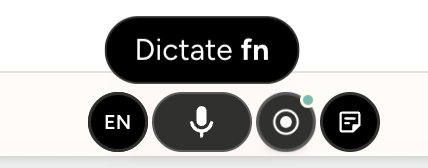
That design choice does two jobs at once. First, it blends into the Apple ecosystem perfectly so it doesn't read as an intrusive third-party app. This lowers the resistance to having it there all the time. Second, and more important, it sits right between your keyboard ans screen making it a constant, low-friction reminder, that there's a faster way to get the words out than typing them.
It isn't an accident, either. Kothari says the bar's exact position came directly out of the 5 to 10 hours a week he spends sitting beside users watching them work: "hey, the flow bar just stays in the bottom of your screen, and for some people it's overlapping with some important stuff that they need to use otherwise. And so, cool, we're going to make it movable." NEW ECONOMIES podcast, YouTube The single most visible piece of the product was tuned by watching real people get annoyed by it.
The founder became the distribution channel
CEO Tanay Kothari wasn't afraid to became the media.
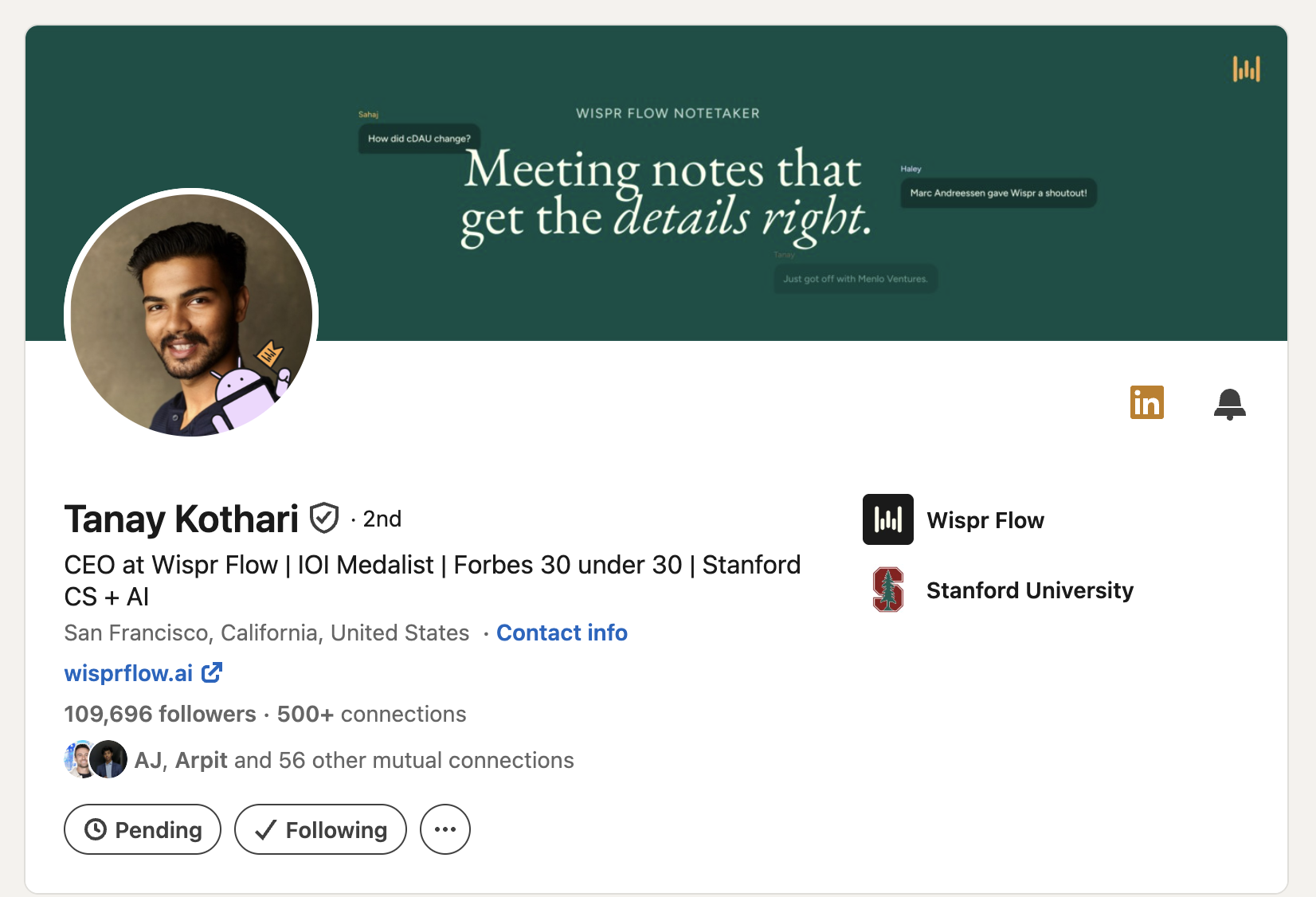
His LinkedIn is at 109,696 followers and 1,941 posts, posted from his own account, in his own voice, constantly ending with "Written with Wispr Flow". On X he's at 34.6K followers under @tankots, and he's built a YouTube channel under the same handle that just started posting and already has 9k subscribers.
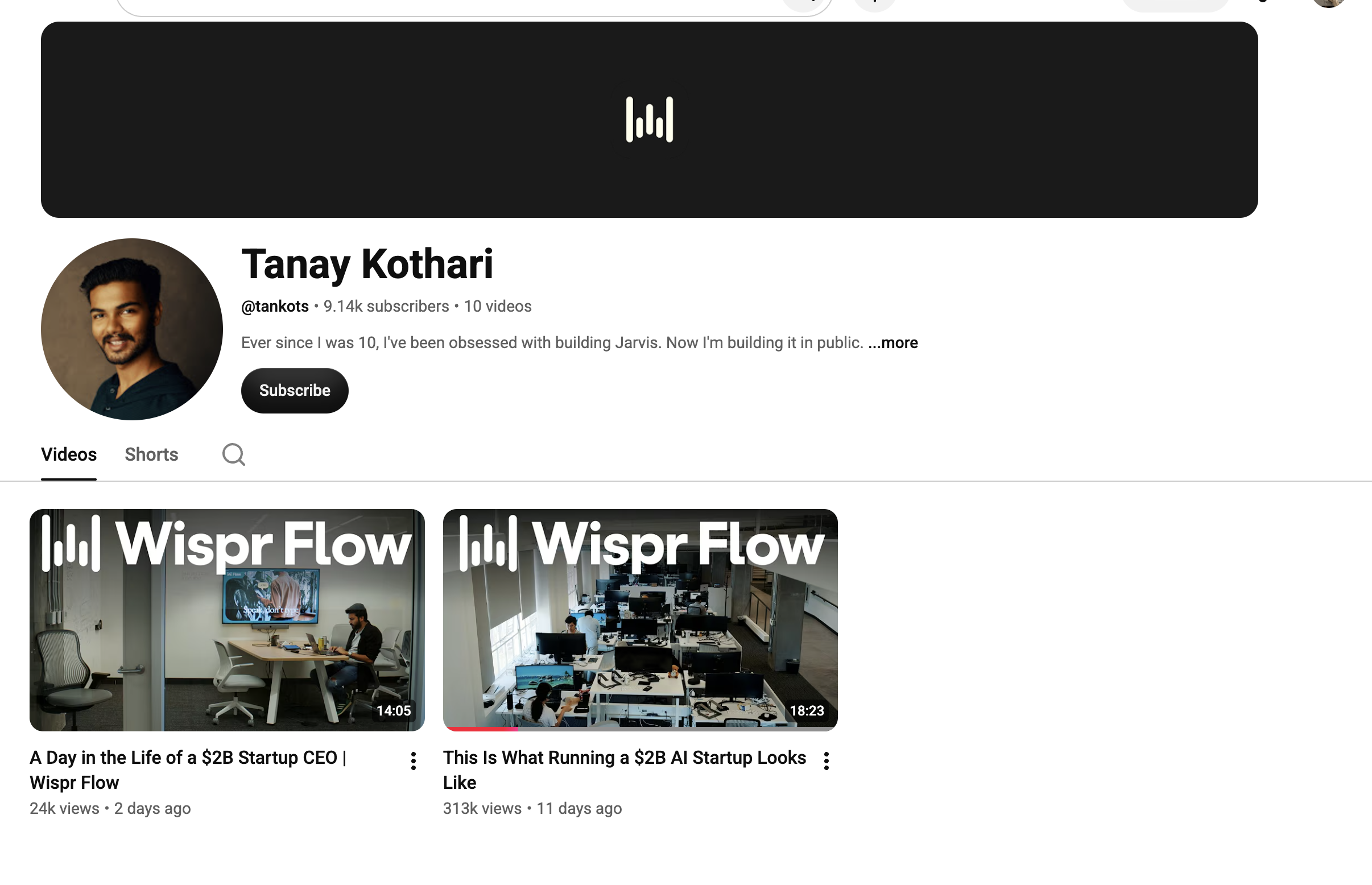
Two recent uploads: "This Is What Running a $2B AI Startup Looks Like" at 313,000 views (impressive for a 18 min video), and "A Day in the Life of a $2B Startup CEO" at 24,000 views two days after posting. Tanay Kothari's YouTube channel
Tanay isn't just doing press, he has a specific bet: the people most likely to evangelize a product are the ones who feel like they know the person building it. A YouTube channel that shows the inside of a $2B startup gives Wispr's evangelists, its lighthouses, a story to follow, not just a product to use. That's a different relationship than a customer has with a company.
The company backs this financially and structurally. Postbeam's growth breakdown of Wispr identifies a Head of Celebrity & Cultural Partnerships, held by Jacob Shwirtz, a role most software companies don't have on the org chart at all. Postbeam, "How Wispr Flow Grows" Kothari's own founder-led content strategy is echoed in the paid channel too: Postbeam reports roughly 60 LinkedIn ads in a 30-day window, and most of them are promoted posts from Kothari himself. The company is quite literally paying to extend the reach of the founder's personal brand.
It gets included, unprompted, in other people's credibility content
Wispr Flow's influencer presence is unusually indirect. Much of it is organic. It shows up inside a tech stack list someone is making for their own reasons. A "here's my tool stack" video where the creator is really trying to prove they're competent at their job, and Wispr Flow is one of the tools that makes the list.
Two examples, pulled and checked directly rather than taken on faith. A creator posting under the pitch "learn these growth and social tools or get left behind" names Wispr Flow as one of three tools, alongside Claude. @gannonbreslin Separately, a creator posting as a "head of social media" lists her full AI stack: ChatGPT, Claude, Wispr Flow, Granola AI, OpusClip, Riverside. @ebony.marketinggirly Her line on Wispr Flow: "This is a massive time saver for me, I voice note almost everything and this app makes it look perfect."
Neither creator is being paid to say any of this (to my knowledge). That's exactly what makes it work as a growth channel.. A viewer isn't being sold to, they're watching someone credible show their receipts, and Wispr Flow is simply one of them. That's a growth through word of mouth that Wispr didn't buy.
Zero-outbound enterprise, funded by consumer habit
Wispr Flow has more than 270 Fortune 500 customers and adds roughly 125 new enterprise accounts a week, without a single SDR or outbound sales motion. Postbeam, "How Wispr Flow Grows" How?: Employees adopt the free or personal-paid product for their own work, gets hooked, then advocate for it inside their own company until it lands as an enterprise deal. Kothari's own words on the venture-capital version of this same loop: "I think every single tier-one venture fund in the valley uses Wispr Flow for their emails, memos, documents, and more. They feel themselves being hooked on it." Computerworld interview
The lesson underneath both is the same: enterprise sales gets replaced entirely when the individual user becomes the sales motion. That only works if the product is genuinely sticky enough that a single user wants to bring it into their next job.
Wispr now counts roughly 15,000 companies as customers, more than half the Fortune 500 among them, named accounts including Microsoft, Nvidia, Notion, Clay, and Klarna, and B2B has grown to about a third of total revenue. He says that transition usually takes 4 to 8 years, citing Slack, Notion, and Canva as reference points, and Wispr did it in about a year. NEW ECONOMIES podcast, YouTube
The part worth stealing is the differentiation he makes between the consumer and the enterprise motion. "You're not selling the same product to the same person," in his words. Consumer buyers want simplicity, emotion, and a flat price, the same $20 that ChatGPT and Claude charge. Enterprise buyers want sophistication: you're no longer selling dictation, you're selling an engineering team shipping faster, and a vision the CIO can defend internally, priced against the outcome rather than the feature. Kothari says companies that try to sell "the same product and the same pricing and packaging with the same problem description" to both buyers hit what he calls the PLG trap, (a product-led motion that grows fast, then S-curves into a ceiling, with the entire enterprise opportunity sitting untouched on the other side of it).
Retention was engineered, not assumed, with one specific fix worth naming
The retention numbers are real: 70 to 80 percent year-one retention, and after roughly five months a user's daily computer activity runs 72 percent through Flow instead of a keyboard. Postbeam, "How Wispr Flow Grows" Kothari's own framing of the cost of getting there: "it's going to be an uphill battle for us, like it is for any tool that requires behavior change, but it's one I'm very happy to take on." Computerworld interview
One specific, fixable failure is worth naming because it's the most transferable lesson in this whole piece: early on, non-technical users would try dictation only inside the Wispr app itself, and never discover it worked everywhere else on their computer. The product was there but onboarding was hiding the value. The team rebuilt onboarding to walk new users directly into the apps they already lived in, email, Slack, docs, instead of demonstrating the feature in isolation, and the retention dip recovered. Most retention problems aren't the product failing to deliver value. They're the user never finding out where the value lives.
Pricing that recruits your coworkers for you
Flow Pro is $15 a month for individuals. Flow Teams is $12 per user with a three-seat minimum. Postbeam, "How Wispr Flow Grows" That's a straight discount for bringing two more people onto the plan, the same bottoms-up mechanic Slack and Claude Teams have used: the cheapest way to lower your own price is to convince your team to join you.
A market most companies would deprioritize, aggressively invested in instead
Between October 2025 and April 2026, India produced 14 percent of downloads but only 2 percent of revenue, the kind of split that usually gets a market quietly deprioritized. Wispr did the opposite: shipped a Hinglish beta for Hindi-English code-switched speech, the way people actually type on WhatsApp, priced a local tier around ₹320 a month against $12 to $15 globally, and opened a Bengaluru office that now holds close to half the company's global headcount. Growth in the market went from 60 percent to 100 percent month-over-month, and India became the company's number two market by both users and revenue, with 75 percent of Indian customers paying annually versus 30 to 40 percent globally, a real trust signal, not just a discount response. Postbeam, "How Wispr Flow Grows"
The pattern: a market that looks unprofitable on a blended global metric can be exactly the market worth a dedicated local product and price, if the download numbers say the demand is already there.
Kothari's own reasoning for why India specifically, and why it worked, goes deeper than the pricing math: "it is one of the countries that's voice first. You see India, you see Brazil. In these countries, people, when you have a quick question for somebody, you just call them, you send voice notes. That is not a very American, European thing anymore." He'd deprioritized India for years on the standard reasoning that the market doesn't pay, then watched organic usage prove that wrong. The launch leaned on a tuk-tuk campaign and a video he calls "the Pasha video," which he says hit 80 to 100 million views. His bar for a market launch, stated directly: "I just want people in that country to feel like this is a product made for people like them." The cautionary example he gives for getting it wrong is Canva in Brazil, which he says got called "a gringo product." NEW ECONOMIES podcast, YouTube
Owning the category in search
Wispr Flow ranks for roughly 443 keywords and pulls about 132,000 monthly organic visits, but the real signal isn't the keyword count, it's what people search. Branded searches for "Wispr Flow" outnumber the generic category term "speech to text" by multiples. Postbeam, "How Wispr Flow Grows" The company backs that with direct comparison pages (Flow vs. Superwhisper, Flow vs. Aqua Voice, Flow vs. MacWhisper) and shows up first in "best dictation apps" roundups. When your brand name outperforms the category name in search volume, the category has started to disappear into the brand, the same effect Kleenex or Google had on their own categories.
When trust broke, the habit bought time the response didn't earn
In November 2025, a Reddit user discovered Wispr storing screenshots and transmitting data despite a "zero data retention" claim. The company's first move was to ban the user who raised it, which is the wrong instinct in public and made the story worse before it got better. The CEO's follow-up, days later, was a public apology that admitted the ban was a mistake and committed to concrete transparency fixes.
Growth reportedly kept compounding through the scandal. The honest read isn't "a strong habit protects you from a trust failure." It's that a strong habit buys you the time to fix a trust failure you shouldn't have had, and shouldn't have mishandled, in the first place. A competitor, Superwhisper, has since built part of its own positioning around "local-only, zero-cloud processing" directly in contrast. The mistake is the part worth studying, not the recovery.
The pattern underneath all of it
None of these nine things would have worked alone. A persistent button with no founder behind it is just a UI choice. A famous founder with a product nobody keeps using is just an influencer with a day job. What made this compound is that every tactic reinforced the same single belief. Speaking is faster than typing, and the product, the founder, the pricing, and even the market expansion all pointed at that one idea from a different angle.
That's the actual takeaway for anyone building a product, not the individual tactics. Pick the one belief you need someone to hold, and then make sure your product, your founder's presence, your pricing, and your growth experiments are all arguing for that same belief instead of eleven different ones.
There's a second question underneath the first one: how does a team run nine tactics at once without falling apart. Kothari's own answer is a rule. He calls unmanaged ambition the real killer, "most companies, I believe, die by suicide, because you make these wrong decisions," and his fix is matching the number of initiatives to the team's actual capacity, not to how much founders want to get done: "if it took five people to build a thing, it actually takes 10 people and 20 people to build and maintain the thing." Every new initiative at Wispr has to clear three questions before anyone starts: is it aligned with the roadmap, is it aligned with what customers are actually asking for, and does the team have the capacity to do it without abandoning what's already live. If the answer to the third question is no, the initiative waits until the team for it exists. NEW ECONOMIES podcast, YouTube Nine tactics is a lot. The discipline isn't running all nine at once, it's refusing to start a tenth until the first nine have the headcount to survive.
— Written with Wispr Flow
Research desk
Sources and notes
- TechCrunch, "Wispr raises $280M at $2B valuation as it looks beyond dictation"
- Tanay Kothari, NEW ECONOMIES podcast with Ollie Forsyth
- Postbeam, "How Wispr Flow Grows"
- Computerworld, Wispr CEO interview
- Tanay Kothari's YouTube channel, @tankots
- @gannonbreslin, TikTok tool-stack video
- @ebony.marketinggirly, TikTok tool-stack video
Last checked August 18, 2026. Public source material supports the observations in this article; it does not establish a single causal explanation for either company’s growth.
The practical layer
Your company already has more warm paths than it can see.
ROBIN maps those relationships and helps growth teams notice the right opportunity before someone thinks to search.
Request access