Issue No. 003 · Deep dive
LlamaIndex Breakdown: Growth Nobody Called Growth
A growth breakdown of LlamaIndex, a real plan for what I'd do differently, and a working demo built with LlamaParse, their own product, to prove all of it.

I wanted to know what growth work actually looks like at a company like LlamaIndex, the kind of AI infrastructure business most people only analyze from the outside. So instead of writing one more opinion post about it, I did the work three ways: a real growth breakdown, a real plan for what I'd do differently, and a real technical demo built with their own product.
Here's what came out of it.
Growth strategy nobody called growth strategy
LlamaIndex started as one tweet.
In November 2022, Jerry Liu was an engineer at Robust Intelligence, juggling four or five customer accounts and losing context between calls. He built a tree-structured index so GPT-3 could hold onto personal data past its 4,000-token limit, called it GPT Tree Index, and tweeted about it to his 20 followers. The tweet got 300 likes. "I was like, holy shit," he said on Composio's podcast.
Today the company gets 25 million downloads a month and has 288,000 followers on LinkedIn.
Jerry never talks about the years in between as a growth strategy. But three of his own decisions look exactly like ones a growth person would make on purpose.
He turned the spike into a place to land. As more people started using the tool, he opened a Discord instead of just riding out the attention. Attention fades, a community doesn't.
He picked a co-founder from a trust relationship, not a cold search. Simon Suo, now CTO, wasn't found through a matching platform. They'd already worked together at Uber's self-driving research lab. "Probably one of the smartest people I've met," Jerry said. When he made his list of potential co-founders, Simon was at the top of it.
He gave away the real thing before he charged for anything. The open-source framework is still free, and the 25 million downloads a month came from people using something genuinely useful. LlamaParse, the paid product, only appeared once the free layer had already built the audience.
None of these are secrets. They're just decisions most technical founders don't make without a growth mindset, which is Murtaza Khomusi's job today, as VP of Marketing.
The full breakdown, with all three decisions in Jerry's own words, is on LinkedIn.
What I'd actually do differently
The company already won the hard part: attention. 25 million downloads a month, 288,000 people on LinkedIn. So the growth job now isn't getting more of it. It's turning the people already around the product into the ones who carry it.
Three moves.
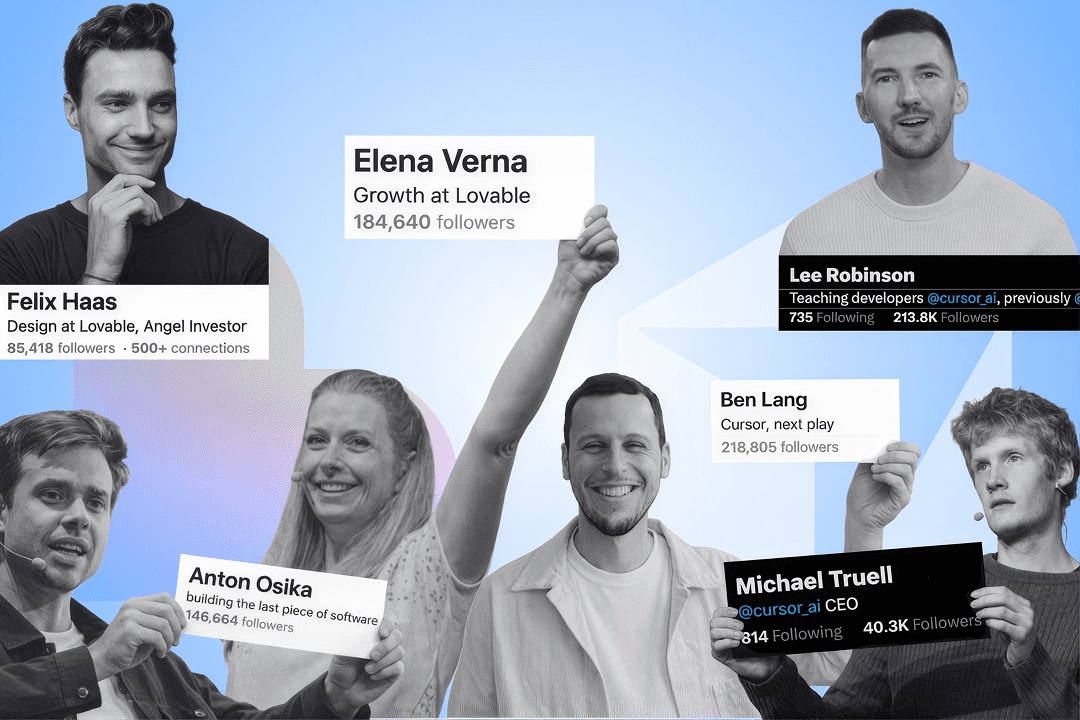
Make the team the media. The company account has 288,000 followers. Jerry has about 49,000 on LinkedIn. Simon has about 11,000. After that it drops off. The brand is bigger than any single person at it. Compare that to Lovable, where the CEO, the head of growth, and the design lead each carry a following of their own, in different lanes. I'd give LlamaIndex one visible builder per function.
Turn every customer into a story. There are 12 logos on the customers page. Four of them have a case study behind them. Carlyle's is a good one: a named lead, a specific problem, a real quote about parsing complex financial documents. Lovable, one of the strongest logos on that wall, has nothing. Build all 12, and make each one speak to that customer's own audience, not just developers.
Bring back the RAG-a-thon. LlamaIndex ran two hackathons in 2024. The second pulled in over 500 sign-ups and 45 shipped projects in a weekend. The recap said they'd definitely do more. Then it stopped. I'd restart it with one rule: every team has to build with LlamaIndex plus a partner company's product. Now every event is a partnership conversation and a room full of new adopters at the same time.
None of this is a new channel. It's activating what's already there.
The full post, with the numbers behind each move, is on LinkedIn.
Then I built the thing
Growth analysis is one kind of proof. Writing working code is another.
I needed a real, messy document, not a clean sample PDF. I picked a 218-page issue of Vogue and went straight for the ugliest page in it: the masthead. Two pages, six-point type, eight columns, roughly 150 names and titles jammed together with no structure at all.
I could have pointed a coding agent straight at those pages. It would have mostly worked, slowly, and it would have dropped names and guessed at titles on type that small. The model isn't the weak link anymore. The messy page is.
So I ran the masthead through LlamaParse first, and let it turn the pages into clean markdown. Then about 40 lines of Python walked that output and pulled out every row: name, title, department. My coding agent never had to look at a page.
Cost: 33 credits, out of the 10,000 the free tier gives you every month. I tried the premium parsing mode too. It returned the exact same 142 rows for 2,205 credits, so the cheap mode was already enough.
That's the actual argument for LlamaIndex, stated plainly: the models are already good. What you feed them is the constraint. Structure the data first, and an ordinary model starts acting like an exceptional one.
The full breakdown, with the code, is on LinkedIn.
The point of the whole week
Proving something in public beats arguing for it. That's also just how I think about growth for anyone else. You're rarely missing the opportunity. Jerry had 20 followers. LlamaIndex has 12 undertold customer stories. A Vogue masthead has always had the exact names a model needs to find. The opportunity is already sitting there. Someone still has to structure it, and hand it to the person who can use it.
Research desk
Sources and notes
- He Built a 25M Download AI Giant from 1 Tweet | Jerry Liu
- This is what I would do if I was running growth at LlamaIndex
- I turned a 218-page Vogue into a 142-person contact list in 40 lines
- Jerry Liu, original GPT Tree Index tweet, November 2022
Last checked September 4, 2026. Public source material supports the observations in this article; it does not establish a single causal explanation for either company’s growth.
The practical layer
Your company already has more warm paths than it can see.
ROBIN maps those relationships and helps growth teams notice the right opportunity before someone thinks to search.
Request accessKeep reading
Deep dive · Robin Lopes
9 Growth Tactics Behind Wispr Flow's $2B Valuation
Wispr Flow didn't aim for one thing to go viral. Instead, a dozen of small, deliberate decisions compounded until people realized speaking is the new typing.

Deep dive · Robin Lopes
Why Lovable and Cursor Turned Distribution into a Team Sport
The strongest startup distribution is not one loud founder. It is a team that gives useful ideas and product context a reason to travel.